
Growth and production of Thai agarophyte cultured in natural pond using the effluent seawater from shrimp culture
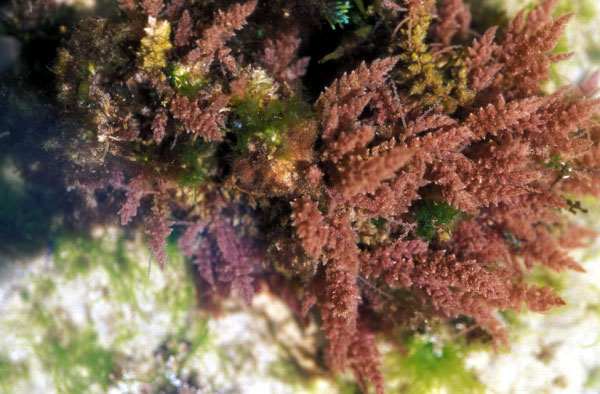
Growth rate determinations of the Thai agarophytes, Gracilaria fisheri (Xia et Abbott) Abbott, Zhang et Xia and G. tenuistipitata Chang et Xia var. liui Chang et Xia, were conducted by monoline method in natural earthen ponds (800 m2 in area) using shrimp pond effluents (PI) and ambient seawater (P2), from January 1998 to July 1999. Generally, plants of both species cultured in PI showed a better growth rate and total production than those cultured in P2. Growth rates and total production of the Gracilaria cultured in PI increased in the rainy months and reached a maximum value on.08 ± 1.14% d-I for G.fisheri and 2.68 ± 1.76% d-I for G. tenuistipitata in January 1999. In contrast, growth of both species cultured in P2, projected a slight change in their growth rates, with a maximum value of 1.85 ± 1.00% d-I for G.fisheri and 1.70 ± 0.49% d- 1 for G. tenuistipitata attained in the rainy period (August 1998). All plants of G. tenuistipitata declined drastically in the following dry season. Total production of G. fisheri and G. tenuistipitata cultured in PI showed the highest value of 1000 g wet wt and 961 g wet wt in January 1999, respectively. Plants of both species showed fluctuation in growth and total production, depending on specific cultured conditions of each pond, algal strain used, and on the season. The results suggest that G. fisheri can be grown all year round and is more suitable than G. tenuistipitata for earthen pond cultivation using shrimp pond effluents.



Marine Agronomy Group, CAFNRM, UH-Hilo
200 W. Kawili st., HI 96720, USA
Contact: Marine.Agronomy.Group@gmail.com
Funding for this web portal is provided by the World Wildlife Fund and the University of Hawaii-Hilo.