
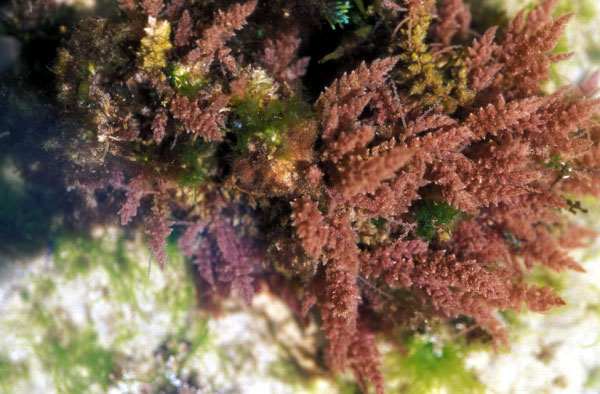
Domestication of indigenous Porphyra (nori) species for commercial cultivation in Northeast America
The red alga Porphyra (commonly called nori), is a major source of food for humans throughout the world and is the most valuable maricultured seaweed in the world today. In 1995, approximately 12 billion sheets (approximately 36,000 metric tons) were produced, with an annual value of more than $1.8 billion. Porphyra is primarily used as the reddish-black wrapping, consisting of chopped, pressed, and toasted blades, around sushi rolls. Nori also is a major source of taurine, which controls blood cholesterol levels, and it is a staple in macrobiotic diets. Nori contains high levels of proteins (25-50 percent), vitamins (higher vitamin C content than in oranges), trace minerals and dietary fiber. It also serves as a preferred source of the red pigment r-phycoerythrin, which utilized as a fluorescent tag in the medical diagnositic industry. The U.S. is primarily dependent upon Japan and to a lesser extent China and Korea, for imports of nori.



Marine Agronomy Group, CAFNRM, UH-Hilo
200 W. Kawili st., HI 96720, USA
Contact: Marine.Agronomy.Group@gmail.com
Funding for this web portal is provided by the World Wildlife Fund and the University of Hawaii-Hilo.