
Beefing up seaweed production to green up beef
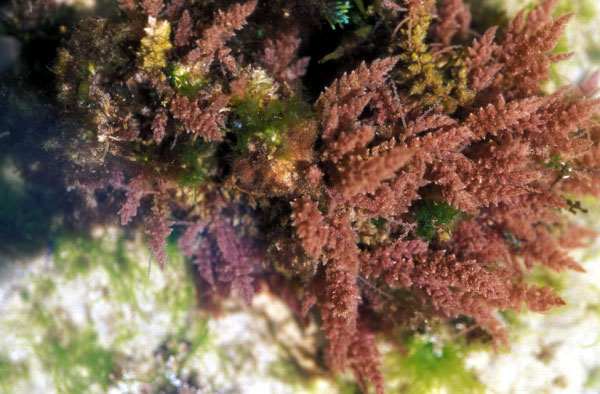
Josh Goldman, founder and CEO of barramundi producer Australis Aquaculture, is on a mission to reproduceAsparagopsis, a tropical seaweed that could signicantly reduce the climate impact of beef production.
Early last year Goldman launched Greener Grazing to develop the technology to produce this pinkish-red sea plant at commercial scale. If it were added to the livestock feed of the world’s 1.5 billion cows, Goldman says it could dramatically reduce theirs and other ruminant animals’ burping of methane gas, which, according to the United Nations, is responsible for 14.5 percent of the world’s annual greenhouse gas emissions.
Goldman read original research from Australia’s James Cook University in 2017 on Asparagopsis’ potential to reduce methane burps. Intrigued, he called the researchers to find out where the seaweed was going to come from.
“They didn’t know – they were chemistry guys,” he said. “But it seemed like an important and interesting challenge to try and close the life cycle of Asparagopsis and accelerate its commercialization, as it could have a major real-world impact.”
Asparagopsis, a delicate, fragile and complex species of tri-phasic seaweed, has not been completely understood or successfully cultivated until recently. It has uniquely high concentrations of halogenated bromoforms, which target the specific microbes responsible for methane production in ruminant animals like cows, leaving more energy for digestion.



Marine Agronomy Group, CAFNRM, UH-Hilo
200 W. Kawili st., HI 96720, USA
Contact: Marine.Agronomy.Group@gmail.com
Funding for this web portal is provided by the World Wildlife Fund and the University of Hawaii-Hilo.