
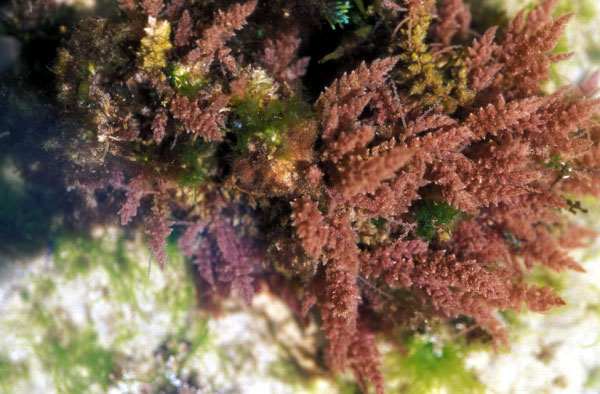
Preliminary study of Eucheuma and Gracilaria culture off Kenya
Bilateral scientific agreements between Kenya and Belgium resulted in 3 marine research projects along the Kenyan coast:
1. 1984-1988. Ecology and management of the coastal zone.
2. 1988-1991. Floristics, faunistics and ecology of Kenyan coastal biotopes.
3. 1989-1991. Dynamics and assessment of Kenyan mangrove ecosystems.
Research is done in and from the Kenya Marine and Fisheries Research Institute at Mombasa.
The local staff scientists working on phycology are mostly interested in developing a proper plan for the harvesting of natural populations, mariculture and use of commercially important seaweeds. It was obvious that a broad survey of the Kenyan coastal water was needed, to look at potential sites for significant stands of commercially important seaweeds. The conclusion of this fieldwork is that there are no beds of such seaweeds available for wild harvest along the Kenyan coast (except maybe for Gracilaria corticata and G. salicornia). Any exploitation of existing stands of commercially important seaweeds will cause irreparable damage to the primary productivity in the coastal zone and drastically change the biotope where they occur.
Therefore the future development of the Kenyan coastal algal resources could only be realized by outdoor seaweed cultivation.



Marine Agronomy Group, CAFNRM, UH-Hilo
200 W. Kawili st., HI 96720, USA
Contact: Marine.Agronomy.Group@gmail.com
Funding for this web portal is provided by the World Wildlife Fund and the University of Hawaii-Hilo.