
Ecology of methanogenic systems in nature
Abstract:
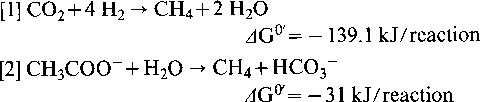
Decomposition in terrestrial and aquatic environments of biogenic or synthetic organic material to inorganic products (also referred to as ‘mineralization’) is predominantly accomplished by microbial oxidations. Under anaerobic conditions, protons, sulfur or carbon atoms are the exclusive electron sinks, products being H2, H2S or CH4 respectively. In this last case, the hydrogénation of CO2 to CH4 or the protonation of the methyl group in acetate (or methylamins) to CH4 are the final reactions:
Keywords:
Sewage Sludge
Link / Ref:
Article Source:
Journal Article in New Trends in Research and Utilization of Solar Energy through Biological Systems
Category:
Basic Biology
Uses of Seaweeds: Miscellaneous


Marine Agronomy Group, CAFNRM, UH-Hilo
200 W. Kawili st., HI 96720, USA
Contact: Marine.Agronomy.Group@gmail.com
Funding for this web portal is provided by the World Wildlife Fund and the University of Hawaii-Hilo.